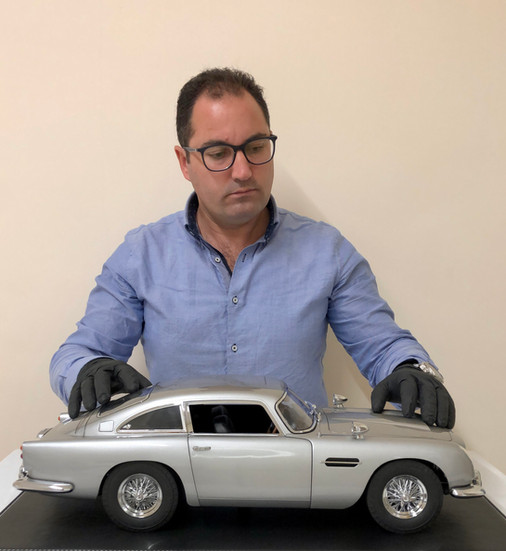
The Miniature World of Marco Laviola
- Mar 7
- 3 min read

Some people reproduce forms. Others pursue a soul.
Marco Laviola belongs to the latter.
Known globally under the name Marlinlav, the Italian artist has transformed the art of scale modeling into something far beyond technical replication. Working at the demanding 1:8 scale, Laviola creates miniature machines that seem to breathe — mechanical sculptures capable of evoking the spirit of the most iconic automobiles in motorsport history and the rarest collector cars.

In a world driven by speed, mass production, and instant gratification, Laviola embraces patience and contemplation. Each model begins with a silent dialogue between the artist and the original car. Through hours of observation and interpretation, the machine gradually reveals its character — a process that ultimately transforms technical accuracy into emotional storytelling.
Perhaps that is why his work has found its way into the private collections of Formula 1 drivers, designers, artists, and Michelin-starred chefs — individuals accustomed to excellence, who instantly recognize the same obsessive pursuit of perfection reflected in Laviola’s creations.

The Art of Detail
For Marco Laviola, model making is not a mechanical craft. It is art.
Every screw, every seat stitch, every reflection on a painted surface carries intention. The goal is not merely to reproduce the form of a car, but to recreate its presence.

“I don’t want my models to simply function,” Laviola explains.
“I want them to live. I want them to breathe.”
His signature 1:8 scale is one of the most unforgiving in the world of model making. At this scale, nothing can be hidden — every imperfection becomes visible, every element must be executed with absolute precision.

“It’s a ruthless scale,” he says. “Everything is visible. Nothing can be concealed. For me, it represents truth as much as technique.”
To achieve this level of authenticity, Laviola works with a wide range of materials: resin, aluminum, metal, rubber, and increasingly advanced 3D-printing technologies. Yet despite the technological tools involved, the essence of his work remains deeply human. His hands follow the guidance of his eyes, and his eyes follow the soul of the machine.
The result is not simply a model — but a miniature universe where engineering precision meets artistic sensitivity.

When Craft Meets Storytelling
Marco Laviola’s creations do not live only on the workbench.
Through social media, particularly Instagram, his atelier has expanded into a global stage where enthusiasts from around the world can follow the evolution of each project. Yet he does not simply post images of finished models. Instead, he reveals fragments of the creative process — moments of concentration, reflections on craftsmanship, and the gradual birth of each tiny mechanical masterpiece.

What truly distinguishes his digital presence are the cinematic videos accompanying many of his creations. Carefully edited with music and rhythm, these visual narratives turn model making into a form of audiovisual art.
“Video is my natural extension,” he explains. “It allows me to share part of the emotion I feel while creating. Music is essential — it must merge with the images and amplify them. I want viewers to feel what I feel when a detail finally comes to life.”
The result feels less like traditional documentation and more like intimate cinema — a quiet celebration of craftsmanship.

Encounters that Shape a Journey
Every craftsman’s journey is marked by meaningful encounters. For Laviola, one of the most significant was his meeting with Nicola Materazzi, the legendary engineer widely known as the father of the Ferrari F40.
Working alongside Materazzi on a model of the Ferrari 125 S left a lasting impact on the Italian artist.

“That model remains in my studio,” Laviola recalls. “It represents a mentor who taught me respect — respect for the car, and respect for the work itself.”
His clientele also reflects the emotional dimension of his work. Some collectors commission exact miniature replicas of the cars they own. Others are former racing drivers seeking to preserve a memory of machines that once defined their careers. For many enthusiasts, these models become tangible connections to automotive legends — objects that preserve dreams in physical form.
Each model tells a story. And each story belongs to someone.

Silence as Inspiration
When the noise of the world becomes overwhelming, Marco Laviola seeks refuge in the sea.
Diving offers him a form of mental reset — a moment of silence that clears the mind and restores balance.
“The water is my natural element,” he says. “It removes the noise. It’s like starting again.”

Only then does he return to his studio, with calmer thoughts and steadier hands, ready to resume the meticulous process of transforming precision into emotion.
Because in Marco Laviola’s world, scale models are not about shrinking reality.
They are about capturing its soul.